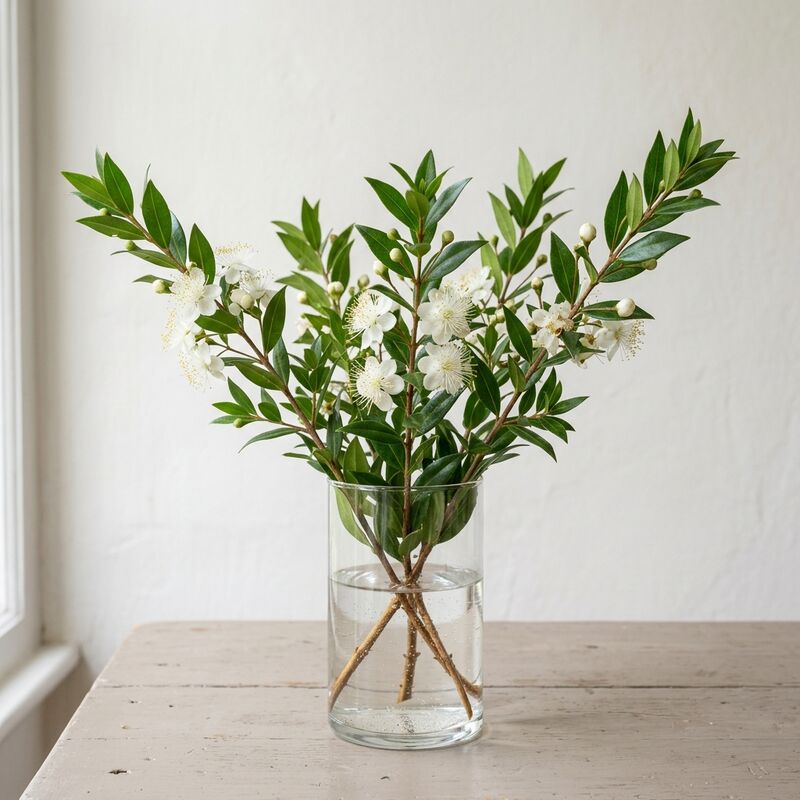
Myrtle: vase life, season, meaning and care for florists
Myrtus communis
Myrtle (Myrtus communis, family Myrtaceae) usually lasts 10–14 days in a vase. In season: Year-round. Fragrance: light. Typical role in a design: foliage.
- Botanical name
- Myrtus communis
- Family
- Myrtaceae
- Accepted name
- Myrtus communis L.
- Role in a design
- Foliage
- Vase life
- 10–14 days
- In season
- Year-round
- Fragrance
- Light
- Colours
- green
- Meaning
- Love and marriage — a traditional sprig in royal wedding bouquets
- Type
- Branch / foliage
- Pets
- Not flagged as toxic in our knowledge base — check the ASPCA list for the exact species
Cut flower commercial monograph
- Official name
- Myrtle
- Botanical name
- Myrtus communis
- Family
- Myrtaceae
- Aliases
- None
- Native origin
- Australia and Oceania
- Growth habit
- Woody perennial shrub or decorative branch with structural lignified stems.
- Stem length
- 80–120 cm
- Natural colours
- Green
- Natural bloom
- Natural flowering in spring and summer
- Commercial supply
- Available year-round via commercial greenhouse production
- Harvest stage
- Harvest when buds show true colour and outer petals loosen (Stage 2–3).
- Vase life
- 10–14 days
- Cold storage
- Cold storage suitable (2–5°C constant temperature, high humidity).
- Special care
- Aromatic, woody and long-lasting: split the stem ends and strip the lower leaves.
- Application
- Serves primarily as Foliage in modern floristry, ideal for table arrangements and event designs.
- Market notes
- Aromatic, woody and long-lasting: split the stem ends and strip the lower leaves.
For florists
Try Myrtle in a client design
We fill in the brief from this page. No stock yet? Load the sample flowers — Myrtle included — and see a recipe, quote and preview image in about a minute. New shops get 30 free credits.
Try it as a design — freeCare and conditioning
- Aromatic, woody and long-lasting: split the stem ends and strip the lower leaves.
Where it fits
| Use | Why | |
|---|---|---|
| Hospital visits and condolences | ✓ | Not strongly scented and no heavy pollen. Check that the ward accepts fresh flowers. |
| Weddings | ✓ | No pollen staining, and it lasts long enough to make up a day ahead. |
| Dining tables and restaurants | ! | Lightly scented — fine in moderation. |
| Homes with cats or dogs | ✓ | Not flagged as toxic in our knowledge base; still check the ASPCA list for the exact species. |
| Making ahead and next-day delivery | ✓ | Long-lasting (about 10–14 days) — good for orders prepared ahead and weekly contract flowers. |
Pairs well with
These are available at the same time as myrtle and have a similar vase life (foliage lasts at least as long), so the arrangement ages evenly:
| Flower | Role | Vase life |
|---|---|---|
| Carnation | Focal flower | 10–14 days |
| Bird of paradise | Focal flower | 10–14 days |
| Orchids (cut) | Focal flower | 10–21 days |
| Statice | Filler flower | 10–14 days |
| Craspedia (billy buttons) | Filler flower | 10–14 days |
| Alstroemeria | Filler flower | 10–14 days |
Substitutes
When myrtle is unavailable, out of season or priced up before a holiday, these fill the same role at the same time of year:
| Flower | Vase life | In season | Fragrance | Pets |
|---|---|---|---|---|
| Monstera leaf | 10–14 days | Year-round | None | mildly toxic |
| Asparagus fern | 10–14 days | Year-round | None | mildly toxic |
| Ivy | 10–14 days | Year-round | None | mildly toxic |
| Fatsia | 10–14 days | Year-round | None | — |
FAQ
How long does myrtle last in a vase?
Usually 10–14 days, depending on variety, origin and conditioning.
When is myrtle in season?
It is available year-round.
How do you keep myrtle fresh?
Aromatic, woody and long-lasting: split the stem ends and strip the lower leaves.
What does myrtle symbolise?
Love and marriage — a traditional sprig in royal wedding bouquets. Flower meanings are popular conventions and vary between cultures.
What can I use instead of myrtle?
Flowers with the same role, an overlapping season and a similar vase life: Monstera leaf, Asparagus fern, Ivy, Fatsia.
Related guides
In season at the same time
RoseLilyCarnationGerbera daisyLisianthusBaby's breathBird of paradiseOrchids (cut)