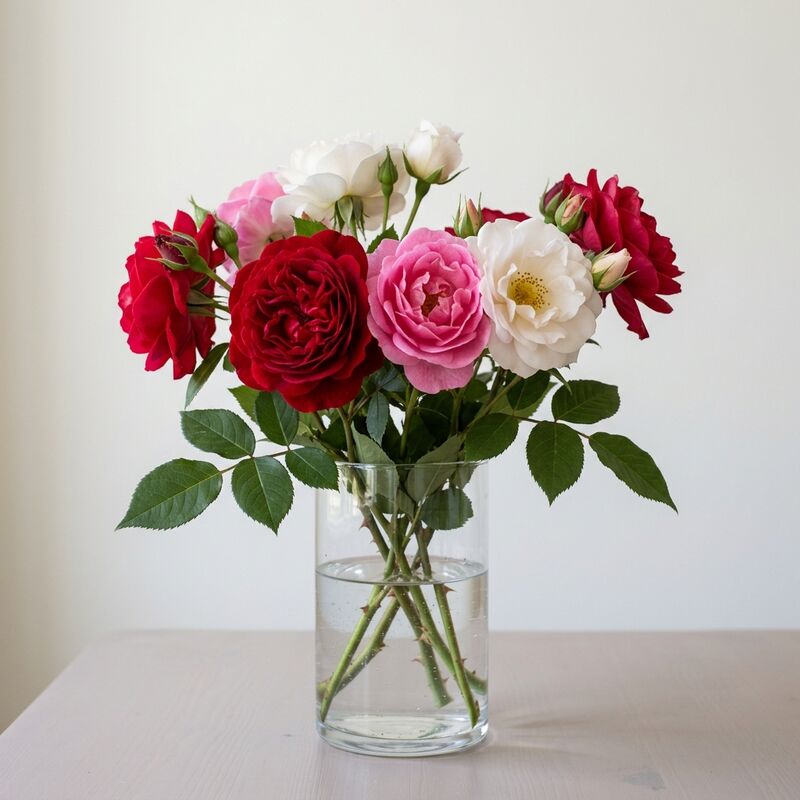
Rose: vase life, season, meaning and care for florists
Rosa × hybrida
Rose (Rosa × hybrida, family Rosaceae) usually lasts 5–7 days in a vase. In season: Year-round. Fragrance: light. Typical role in a design: focal flower.
- Botanical name
- Rosa × hybrida
- Family
- Rosaceae
- Role in a design
- Focal flower
- Vase life
- 5–7 days
- In season
- Year-round
- Fragrance
- Light
- Colours
- red, pink, white, yellow, orange, purple, green
- Meaning
- Love and romance
- Type
- Cut flower
- Pets
- Listed by the ASPCA as non-toxic to cats and dogs (ASPCA entry: Rosa species)
Cut flower commercial monograph
- Official name
- Rose
- Botanical name
- Rosa × hybrida
- Family
- Rosaceae
- Aliases
- None
- Native origin
- Temperate regions of the Northern Hemisphere, predominantly East Asia and Europe
- Growth habit
- Herbaceous perennial or biennial with sturdy, upright flowering stems.
- Stem length
- 50–70 cm
- Natural colours
- Red, Pink, White, Yellow, Orange, Purple, Green
- Natural bloom
- Natural flowering in spring and summer
- Commercial supply
- Available year-round via commercial greenhouse production
- Harvest stage
- Harvest when buds show true colour and outer petals loosen (Stage 2–3).
- Vase life
- 5–7 days
- Cold storage
- Cold storage suitable (2–5°C constant temperature, high humidity).
- Special care
- Recut 2–3 cm under water and strip leaves and thorns below the waterline. A drooping "bent neck" usually means an air block: recut and stand the stems deep in warm water for an hour. Peel off only the bruised outer guard petals.
- Application
- Serves primarily as Focal flower in modern floristry, ideal for table arrangements and event designs.
- Market notes
- Recut 2–3 cm under water and strip leaves and thorns below the waterline. A drooping "bent neck" usually means an air block: recut and stand the stems deep in warm water for an hour. Peel off only the bruised outer guard petals.
For florists
Try Rose in a client design
We fill in the brief from this page. No stock yet? Load the sample flowers — Rose included — and see a recipe, quote and preview image in about a minute. New shops get 30 free credits.
Try it as a design — freeCare and conditioning
- Recut 2–3 cm under water and strip leaves and thorns below the waterline. A drooping "bent neck" usually means an air block: recut and stand the stems deep in warm water for an hour. Peel off only the bruised outer guard petals.
- Rose dries well: hang small bunches upside down in a dark, airy place for two to three weeks.
Where it fits
| Use | Why | |
|---|---|---|
| Hospital visits and condolences | ✓ | Not strongly scented and no heavy pollen. Check that the ward accepts fresh flowers. |
| Weddings | ✓ | No pollen staining, and it lasts long enough to make up a day ahead. |
| Dining tables and restaurants | ! | Lightly scented — fine in moderation. |
| Homes with cats or dogs | ✓ | Listed by the ASPCA as non-toxic to cats and dogs (entry: Rosa species). Check the other stems in the bouquet too. |
| Making ahead and next-day delivery | ✓ | About 5–7 days in a vase — fine to make up a day ahead. |
Pairs well with
These are available at the same time as rose and have a similar vase life (foliage lasts at least as long), so the arrangement ages evenly:
| Flower | Role | Vase life |
|---|---|---|
| Baby's breath | Filler flower | 7–10 days |
| Bouvardia | Filler flower | 7–10 days |
| Canterbury bells | Line flower | 5–8 days |
| Crocosmia | Line flower | 5–8 days |
| Eucalyptus | Foliage | 10–14 days |
| Monstera leaf | Foliage | 10–14 days |
Substitutes
When rose is unavailable, out of season or priced up before a holiday, these fill the same role at the same time of year:
| Flower | Vase life | In season | Fragrance | Pets |
|---|---|---|---|---|
| Gerbera daisy | 6–10 days | Year-round | None | ✓ ASPCA non-toxic |
| Carnation | 10–14 days | Year-round | Light | mildly toxic |
| Lily | 7–10 days | Year-round | Strong | ⚠ toxic to cats |
| Calla lily | 7–10 days | Year-round | None | mildly toxic |
Holiday price surges
| Holiday | Market | Dates | Typical price | Stock up |
|---|---|---|---|---|
| Valentine's Day | Worldwide | 2026-02-14 2027-02-14 2028-02-14 | 2–3× | 21 days ahead |
| Women's Day | Chinese mainland | 2026-03-08 2027-03-08 2028-03-08 | 1.2–1.5× | 14 days ahead |
| White Day | Japan, Korea | 2026-03-14 2027-03-14 2028-03-14 | 1.2–1.5× | 14 days ahead |
| Mother's Day | Chinese mainland, United States, Japan | 2026-05-10 2027-05-09 2028-05-14 | 1.5–2.5× | 21 days ahead |
| 520 (May 20) | Chinese mainland | 2026-05-20 2027-05-20 2028-05-20 | 1.5–2× | 14 days ahead |
| Qixi | Chinese mainland | 2026-08-19 2027-08-08 2028-08-26 | 1.5–2.5× | 21 days ahead |
FAQ
How long does rose last in a vase?
Usually 5–7 days, depending on variety, origin and conditioning.
When is rose in season?
It is available year-round.
How do you keep rose fresh?
Recut 2–3 cm under water and strip leaves and thorns below the waterline. A drooping "bent neck" usually means an air block: recut and stand the stems deep in warm water for an hour. Peel off only the bruised outer guard petals.
What does rose symbolise?
Love and romance. Flower meanings are popular conventions and vary between cultures.
What colours does rose come in?
Naturally in red, pink, white, yellow, orange, purple, green (not counting dyed stems).
What can I use instead of rose?
Flowers with the same role, an overlapping season and a similar vase life: Gerbera daisy, Carnation, Lily, Calla lily.
Can rose be dried?
Yes. Hang small bunches upside down in a dark, airy place for two to three weeks.
Does rose get more expensive before holidays?
Before Valentine's Day, wholesale prices typically run 2–3× normal (stock up about 21 days ahead); before Women's Day, wholesale prices typically run 1.2–1.5× normal (stock up about 14 days ahead); before White Day, wholesale prices typically run 1.2–1.5× normal (stock up about 14 days ahead); before Mother's Day, wholesale prices typically run 1.5–2.5× normal (stock up about 21 days ahead); before 520 (May 20), wholesale prices typically run 1.5–2× normal (stock up about 14 days ahead); before Qixi, wholesale prices typically run 1.5–2.5× normal (stock up about 21 days ahead).
Related guides
In season at the same time
LilyCarnationGerbera daisyLisianthusBaby's breathBird of paradiseOrchids (cut)Eucalyptus