Matthiola W.T.Aiton
stocks · Brassicaceae
- Accepted name
- Matthiola W.T.Aiton
- First published
- Hortus Kew., ed. 2. 4: 119 (1812)
- Family
- Brassicaceae
- Accepted species
- 54 (including 0 natural hybrids)
- Native range
- 64 TDWG regions, Europe to south-central Siberia and the Himalaya, Macaronesia to Arabia, and north-east tropical and southern Africa
- Common names
- stocks
- Databases
- POWO · IPNI · WCVP · Catalogue of Life · GBIF
Overview
Matthiola belongs to the cabbage family, Brassicaceae; Kew gives its native range as Europe to south-central Siberia and the Himalaya, Macaronesia to Arabia, and north-east tropical and southern Africa. Flora of Somalia gives some 50–60 species, mostly in the eastern Mediterranean and Iranian regions. The florist’s stock is M. incana, which WCVP records as native along the northern Mediterranean, from Spain, France, Italy, Greece and Albania to Lebanon–Syria.
Classification and characters
WCVP cites the second edition of W. T. Aiton’s Hortus Kewensis (1812) as the place of publication. Flora of Tropical East Africa describes annual herbs to subshrubs, more or less branched; petals purplish, violet or dirty white and clearly clawed; the fruit a linear silique, round or flattened, sometimes beaded, without cross-walls; and a nearly stalkless, conical, two-lobed stigma. Flora of Somalia adds that the flowers are large with pink to purple petals.
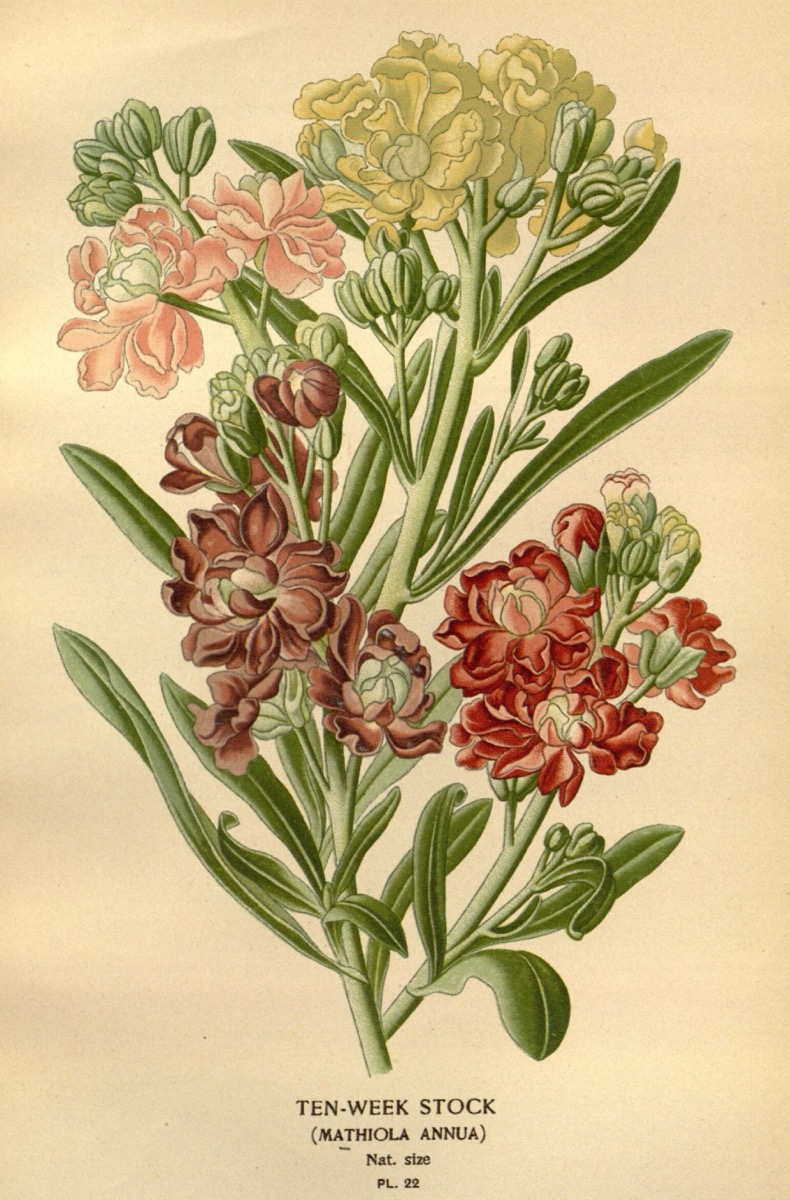
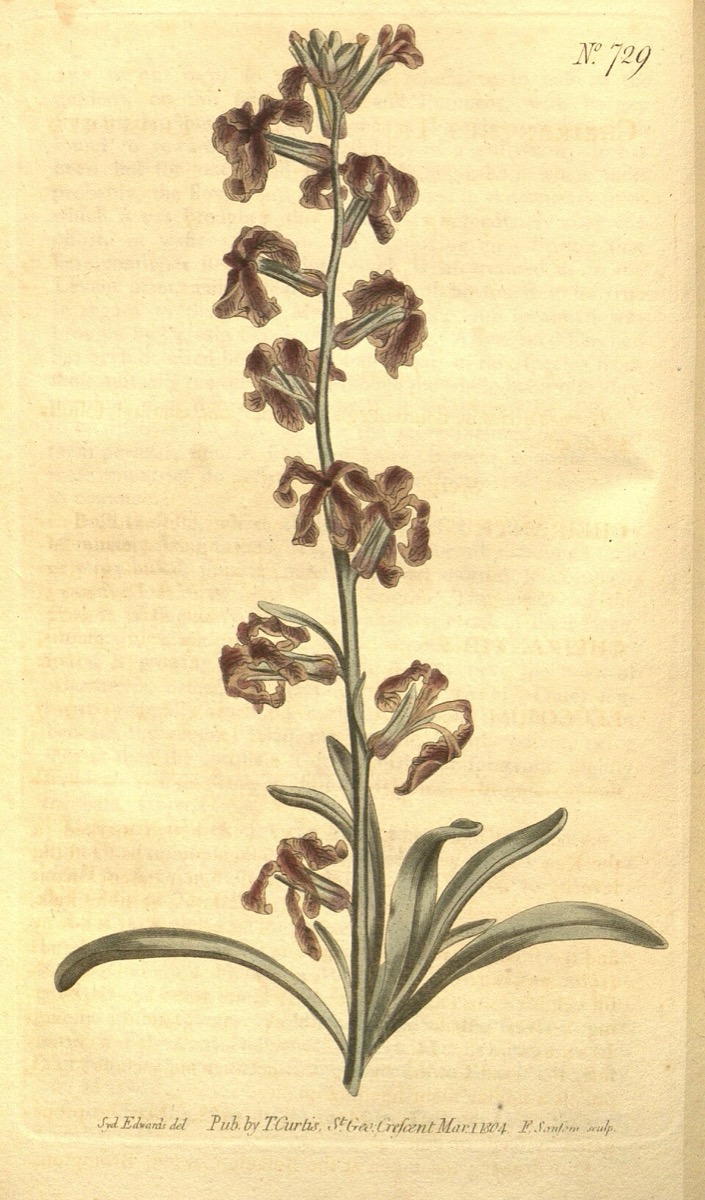
The plate above, Favourite Flowers plate 22 (1896), shows the ten-week stock, printed Mathiola annua; WCVP places Matthiola annua under M. incana subsp. incana.
| Genus name | Published in |
|---|---|
| Acinotum Rchb. | Handb. Nat. Pfl.-Syst.: 260 (1837) |
| Gakenia Heist. ex Fabr. | Enum. Meth. Pl.: 161 (1759) |
| Mathiolaria Chevall. | Fl. Gén. Env. Paris, ed. 2, 2: 910 (1836) |
| Mattiola Sanguin. | Atti Accad. Pontif. Sci. Nuovi Lincei 15: 36 (1862) |
| Promicrantha Dvořák | Folia Prir. Fak. Univ. J. E. Purkyne 13(4): 55 (1972) |
| Triceras Andrz. ex Rchb. | Consp. Regn. Veg.: 185 (1828) |
Distribution
WCVP records the genus as native to 64 TDWG botanical regions and introduced in 30 more.
Native regions (64)
AfghanistanAlbaniaAlgeriaBalearesBulgariaCanary Is.Cape ProvincesCentral European RussiaCorseCyprusDjiboutiEast Aegean Is.East European RussiaEgyptEthiopiaFranceFree StateGreat BritainGreeceIranIraqIrelandItalyKazakhstanKenyaKirgizstanKrasnoyarskKritiKrymKuwaitLebanon-SyriaLesothoLibyaMadeiraMauritaniaMongoliaMoroccoNamibiaNorth CaucasusNorthern ProvincesNW. Balkan Pen.PakistanPalestinePortugalSardegnaSaudi ArabiaSiciliaSinaiSomaliaSouth European RussiaSpainSwitzerlandTadzhikistanTibetTranscaucasusTunisiaTürkiyeTürkiye-in-EuropeTurkmenistanUkraineUzbekistanWest HimalayaWestern SaharaXinjiang
Introduced
AlbertaArgentina SouthArizonaAzoresBaltic StatesBermudaBoliviaCaliforniaCaroline Is.Chile NorthColombiaCzechia-SlovakiaEcuadorGermanyIllinoisJuan Fernández Is.Mexico NorthwestMexico SouthwestNew MexicoNorfolk Is.OntarioPeruPrimoryeRomaniaSaskatchewanSouth AustraliaTasmaniaTexasVictoriaWestern Australia
Accepted species
WCVP accepts 54 species; names with × are natural hybrids. The count changes with revisions; checked 2026-10-24.
| Name | On this site |
|---|---|
| Matthiola afghanica Rech.f. & Köie | |
| Matthiola arabica Boiss. | |
| Matthiola aspera Boiss. | |
| Matthiola boissieri Grossh. | |
| Matthiola bolleana Webb ex Christ | |
| Matthiola bucharica Czerniak. | |
| Matthiola caspica (N.Busch) Grossh. | |
| Matthiola chenopodiifolia Fisch. & C.A.Mey. | |
| Matthiola chorassanica Bunge ex Boiss. | |
| Matthiola codringtonii Rech.f. | |
| Matthiola crassifolia Boiss. & Gaill. | |
| Matthiola czerniakowskae Botsch. & Vved. | |
| Matthiola daghestanica (Conti) N.Busch | |
| Matthiola damascena Boiss. | |
| Matthiola dumulosa Boiss. & Buhse | |
| Matthiola erlangeriana Engl. | |
| Matthiola farinosa Bunge ex Boiss. | |
| Matthiola flavida Boiss. | |
| Matthiola fragrans (Fisch.) Bunge | |
| Matthiola fruticulosa (L.) Maire | 1 plate |
| Matthiola ghorana Rech.f. | |
| Matthiola glutinosa Jafri | |
| Matthiola graminea Rech.f. | |
| Matthiola incana (L.) W.T.Aiton | 1 plate |
| Matthiola integrifolia Kom. | |
| Matthiola kralikii Pomel | |
| Matthiola longipetala (Vent.) DC. | |
| Matthiola lunata DC. | |
| Matthiola macranica Rech.f. | |
| Matthiola maderensis Lowe | |
| Matthiola maroccana Coss. | |
| Matthiola montana Boiss. | |
| Matthiola obovata Bunge | |
| Matthiola odoratissima (M.Bieb.) W.T.Aiton | |
| Matthiola parviflora (Schousb.) W.T.Aiton | |
| Matthiola perennis Conti | |
| Matthiola perpusilla Rech.f. | |
| Matthiola puntensis Hedge & A.G.Mill. | |
| Matthiola revoluta Bunge ex Boiss. | |
| Matthiola robusta Bunge | |
| Matthiola scapifera Humbert | |
| Matthiola shehbazii Ranjbar & Karami | |
| Matthiola shiraziana Zeraatkar, Khosravi, F.Ghahrem., Al-Shehbaz & Assadi | |
| Matthiola sinuata (L.) W.T.Aiton | |
| Matthiola spathulata Conti | |
| Matthiola stoddartii Bunge | |
| Matthiola superba Conti | |
| Matthiola tatarica (Pall.) DC. | |
| Matthiola taurica (Conti) Grossh. | |
| Matthiola tianschanica Sarkisova | |
| Matthiola tomentosa Bél. | |
| Matthiola torulosa (Thunb.) DC. | |
| Matthiola tricuspidata (L.) W.T.Aiton | |
| Matthiola trojana Dirmenci, Satıl & Tümen |
Historic plates
Plates in date order; the printed names are kept as they appear, current names are on the species pages and the topic page.
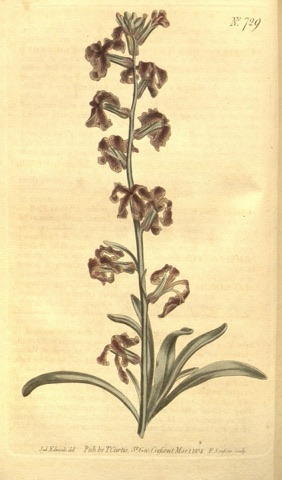
Cheiranthus tristis
Curtis's Botanical Magazine · 729 · 1804
Sydenham Edwards
Ten-week Stock (Mathiola annua)
Favourite Flowers of Garden and Greenhouse · Pl. 22 · 1896
Cut-flower handling
Floralife says stocks are harvested when about six florets are open; avoid spikes with yellow leaves or discoloured or infected florets. Store at 1–3 °C and 75–85% relative humidity; vase life is 5–10 days, and they do well in foam if hydrated enough. Ethylene sensitivity is medium to high, accelerating senescence and causing water-soaked petals and downward-curling leaves, so treatment with an ethylene action inhibitor or STS is recommended.
Stocks foul the water rapidly and bacteria impede uptake, so change the solution frequently and check levels daily. They have a pleasing clove-like scent. They are susceptible to botrytis and mildew: treat against botrytis before transport and storage and keep buckets and vases clean; they need air around them, as massing them too tightly makes the florets deteriorate. Leaf yellowing comes from poor growing conditions or improper handling in storage and transport.