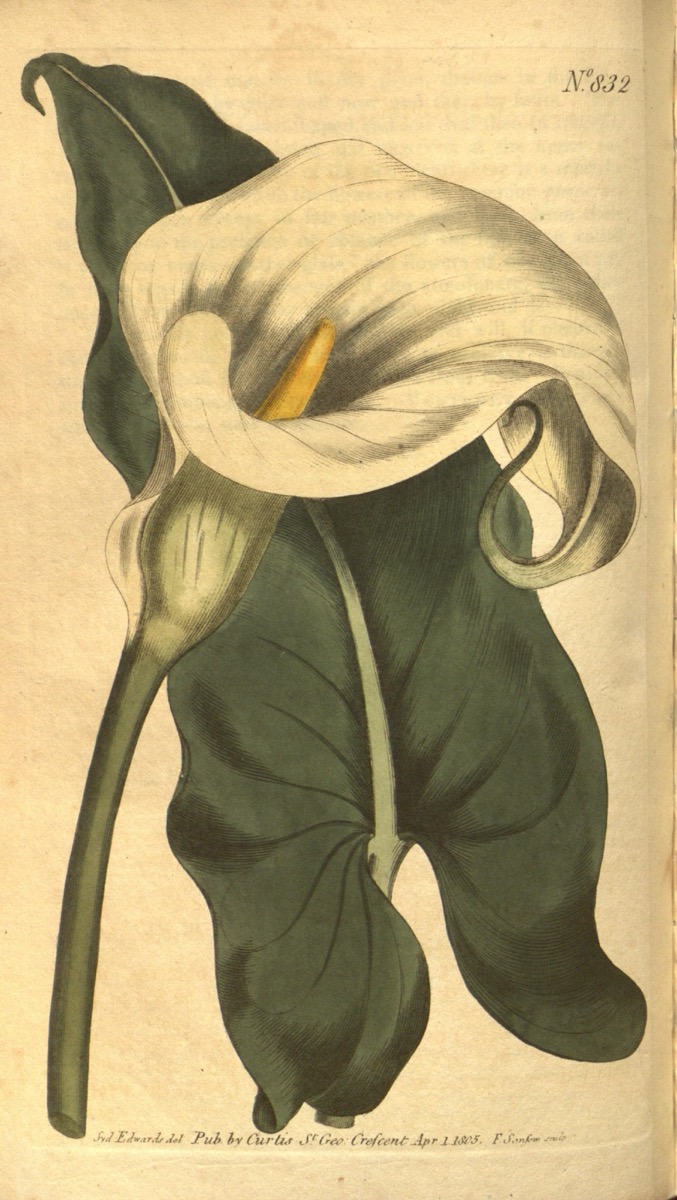
Zantedeschia Spreng.
calla lilies and arum lilies · Araceae
- Accepted name
- Zantedeschia Spreng.
- First published
- Syst. Veg., ed. 16. 3: 765 (1826)
- Family
- Araceae
- Accepted species
- 10 (including 2 natural hybrids)
- Native range
- 15 TDWG regions, Africa: Nigeria to Tanzania and southern Africa
- Common names
- calla lilies and arum lilies, Calla lily
- Databases
- POWO · IPNI · WCVP · Catalogue of Life · GBIF
Overview
Zantedeschia belongs to the arum family, Araceae, and occurs only in Africa: Kew gives the native range as Nigeria to Tanzania and southern Africa, and the RHS says the plants come from swampy regions of eastern and southern Africa. SANBI points out that the English name arum lily is misleading: it is neither an Arum nor a lily (Lilium).
Florists meet two kinds. The white Z. aethiopica is, according to the RHS, the only hardy species widely available in the UK and a long-standing bridal flower; there are forms such as the pink-spathed ‘Marshmallow’ and green-and-white ‘Green Goddess’ (SANBI). Coloured callas are mainly cultivars of Z. elliottiana and Z. rehmannii, and most will not survive below 5 °C, so they must come indoors before frost (RHS).
Classification and characters
Sprengel published the name in 1826; it is conserved (nom. cons.). It honours a Professor Zantedeschi, according to SANBI probably the Italian physician and botanist Giovanni Zantedeschi (1773–1846), though this is not certain. The epithet aethiopica does not refer to Ethiopia: in classical times it meant the lands south of Egypt and Libya.
The plants are geophytes with tubers or short rhizomes, and lanceolate to hastate-sagittate leaves that are often spotted; they grow in damp open places in the tropics and subtropics, including seasonally wet ground and stream banks (CATE Araceae). What looks like the flower is the spathe, white, cream, yellow, pink or rosy purple; the true flowers are packed on the central spadix. SANBI notes that the leaves of the white arum have water pores that shed excess water (guttation), which lets the plant grow in wet ground. Flora Zambesiaca gives 8 species, most in South Africa, and SANBI lists 7; the species WCVP accepts today are in the table below.
| Genus name | Published in |
|---|---|
| Arodes Heist. ex Kuntze | Revis. Gen. Pl. 2: 739 (1891) |
| Colocasia Link | Diss. Bot.: 77 (1795) |
| Houttinia Neck. | Elem. Bot. 3: 291 (1790) |
| Otosma Raf. | New Fl. 2: 90 (1837) |
| Pseudohomalomena A.D.Hawkes | Madroño 11: 147 (1951) |
| Richardia Kunth | Mém. Mus. Hist. Nat. 4: 437 (1818) |
Distribution
WCVP records the genus as native to 15 TDWG botanical regions and introduced in 47 more.
AngolaCameroonCape ProvincesDR CongoEswatiniFree StateKwaZulu-NatalLesothoMalawiMozambiqueNigeriaNorthern ProvincesTanzaniaZambiaZimbabwe
Introduced
Introduced regions (47)
AlbaniaAlgeriaAssamAzoresBermudaBrazil NortheastCaliforniaCanary Is.ColombiaCorseCosta RicaDominican RepublicEast Aegean Is.East HimalayaEcuadorGreat BritainGreeceHawaiiIndiaIrelandItalyMadeiraMexico SouthwestMoroccoNew South WalesNew Zealand NorthNicaraguaNorfolk Is.NW. Balkan Pen.OregonPhilippinesPortugalPuerto RicoRéunionSardegnaSiciliaSociety Is.South AustraliaSpainSt.HelenaTasmaniaTrinidad-TobagoTristan da CunhaTunisiaTürkiyeVictoriaWestern Australia
Accepted species
WCVP accepts 10 species; names with × are natural hybrids. The count changes with revisions; checked 2026-10-24.
| Name | On this site |
|---|---|
| Zantedeschia aethiopica (L.) Spreng. | 4 plates |
| Zantedeschia albomaculata (Hook.) Baill. | 1 plate |
| Zantedeschia × cantabrigiensis (Lynch) J.M.H.Shaw | |
| Zantedeschia elliottiana (H.Knight) Engl. | |
| Zantedeschia jucunda Letty | |
| Zantedeschia odorata P.L.Perry | |
| Zantedeschia pentlandii (R.Whyte ex W.Watson) Wittm. | |
| Zantedeschia × poikilochroma J.M.H.Shaw | |
| Zantedeschia rehmannii Engl. | |
| Zantedeschia valida (Letty) Y.Singh |
Historic plates
Plates in date order; the printed names are kept as they appear, current names are on the species pages and the topic page.
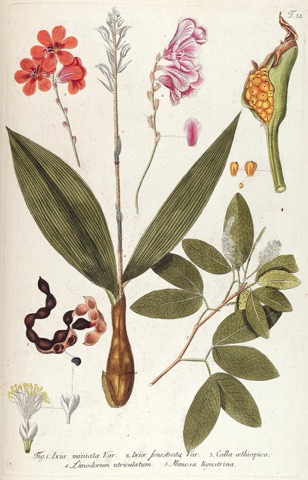
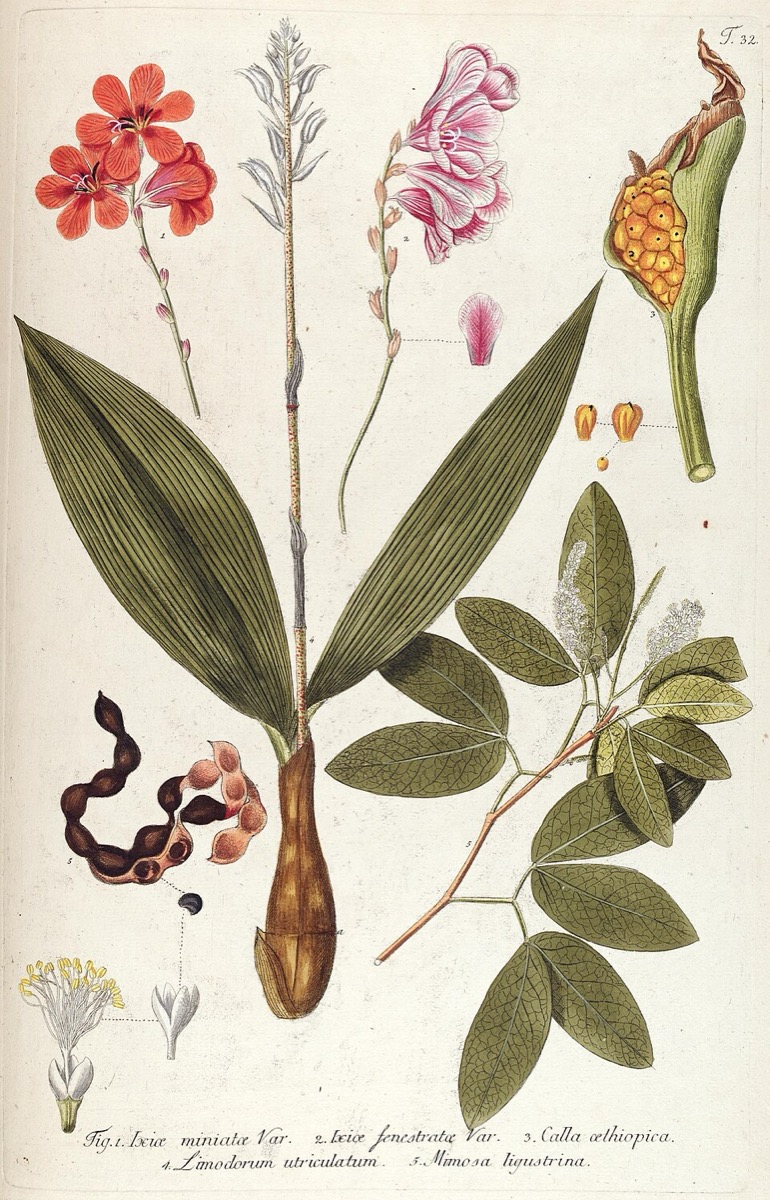
Calla æthiopica
Fragmenta Botanica, figuris coloratis illustrata · 32 · 1800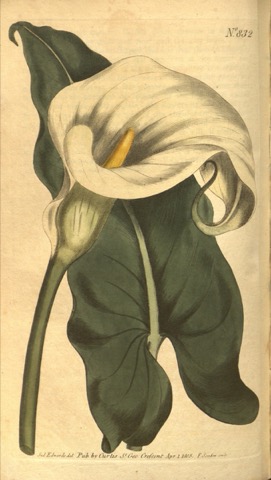
Calla aethiopica
Curtis's Botanical Magazine · 832 · 1805
Sydenham Edwards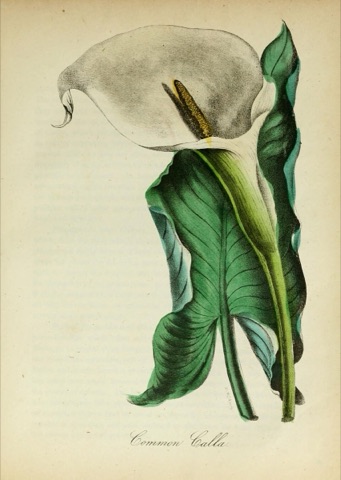
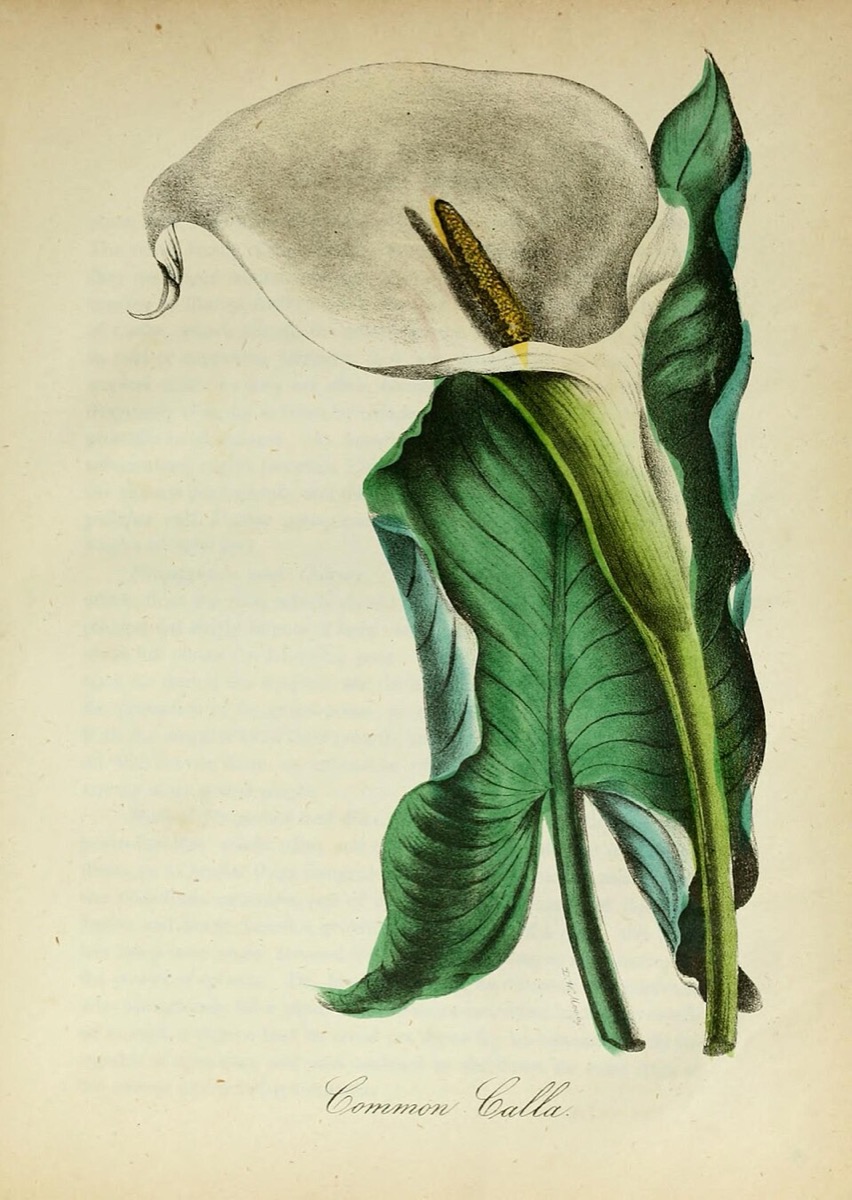
Common Calla
The American Flora · 36 · 1855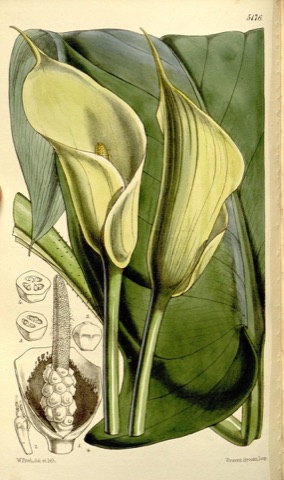
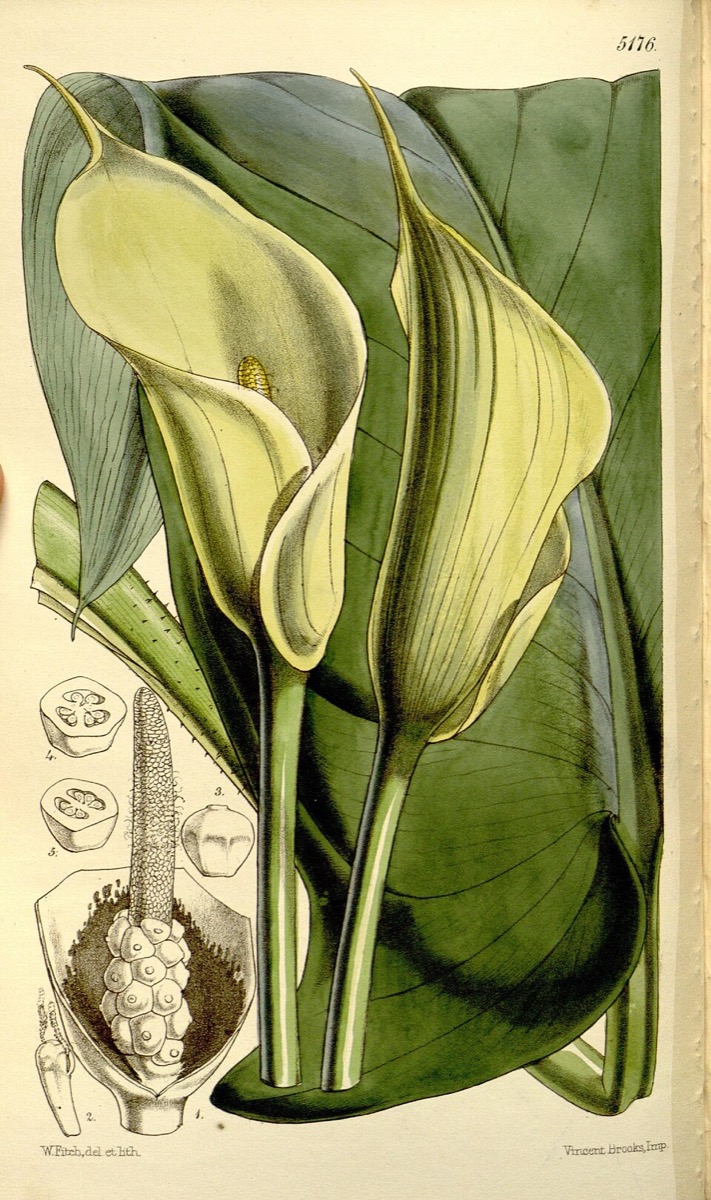
Richardia albomaculata
Curtis's Botanical Magazine · 5176 · 1860
Walter Hood Fitch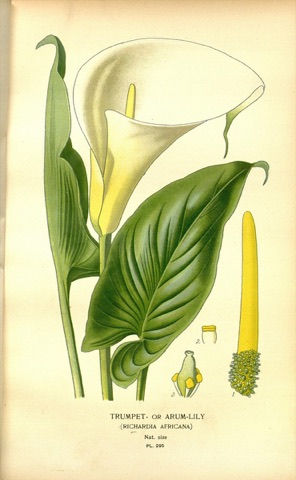
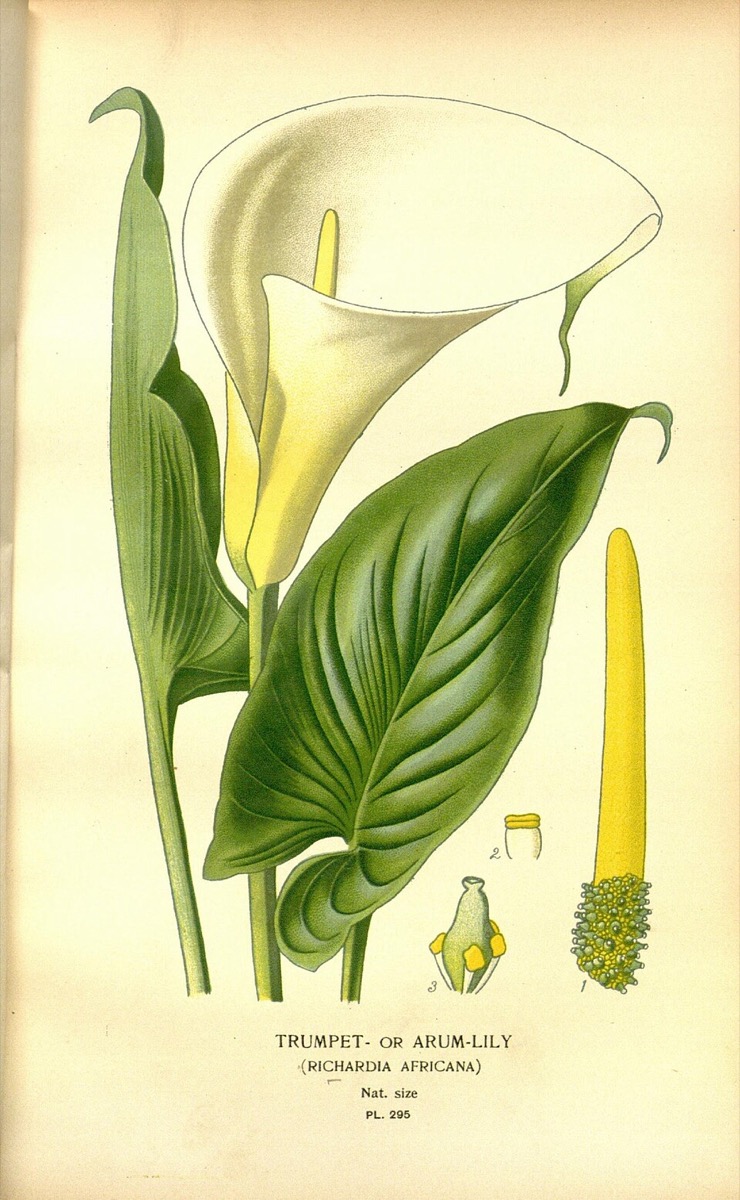
Richardia africana
Favourite Flowers of Garden and Greenhouse · Pl. 295 · 1897
Cut-flower harvest and handling
Floralife advises harvesting when the spathe has opened enough to show the spadix; flowers cut too early may not open fully. Store at 1–3 °C and 75–85% relative humidity; vase life is 4–10 days and ethylene sensitivity is low. Handle callas as little as possible, especially the spathes, and hold them only by the stem. When buying, look for pliable stems; stems that snap when bent are past their prime.
Cut stems drip for a while, and the ends can split and curl; some report that a sugar-based flower food reduces this. The sap stains clothing, but the stain only shows after laundering, so cover the stem ends in bouquets and buttonholes. Callas can go in foam but last longer in a vase; watch for botrytis. SANBI notes that raw plant material contains sharp calcium oxalate crystals that make the throat swell if eaten.
References
- WCVP · World Checklist of Vascular Plants (via ChecklistBank dataset 2232) · accessed 2026-10-24
- Kew (POWO data on the ColPlanta site) · Zantedeschia, with notes from CATE Araceae and Flora Zambesiaca
- RHS · How to grow zantedeschia
- SANBI PlantZAfrica · Zantedeschia aethiopica (Alice Aubrey, 2001)
- Floralife · Calla lily care and handling