Leucadendron R.Br.
conebushes · Proteaceae
- Accepted name
- Leucadendron R.Br.
- First published
- Trans. Linn. Soc. London 10: 50 (1810)
- Family
- Proteaceae
- Accepted species
- 85 (including 0 natural hybrids)
- Native range
- 2 TDWG regions, the Cape Provinces to KwaZulu-Natal, South Africa
- Common names
- conebushes, Leucadendron
- Databases
- POWO · IPNI · WCVP · Catalogue of Life · GBIF
Overview
Leucadendron belongs to the protea family, Proteaceae, and occurs only in South Africa: Kew gives its native range as the Cape Provinces to KwaZulu-Natal. SANBI gives 83 species, most in the Western and Eastern Cape with a few outliers in KwaZulu-Natal. All are dioecious shrubs or trees, and the female heads form woody cones in which the fruits are borne, hence the name conebush. Florists use mainly the coloured involucral leaves and foliage.
The name comes from the Greek leukos (white) and dendron (tree), after the silver tree, L. argenteum, on which the genus is based: its leaves are covered on both sides with silky silver hairs, and it is an endangered species found only on the Cape Peninsula (SANBI).
Classification and naming
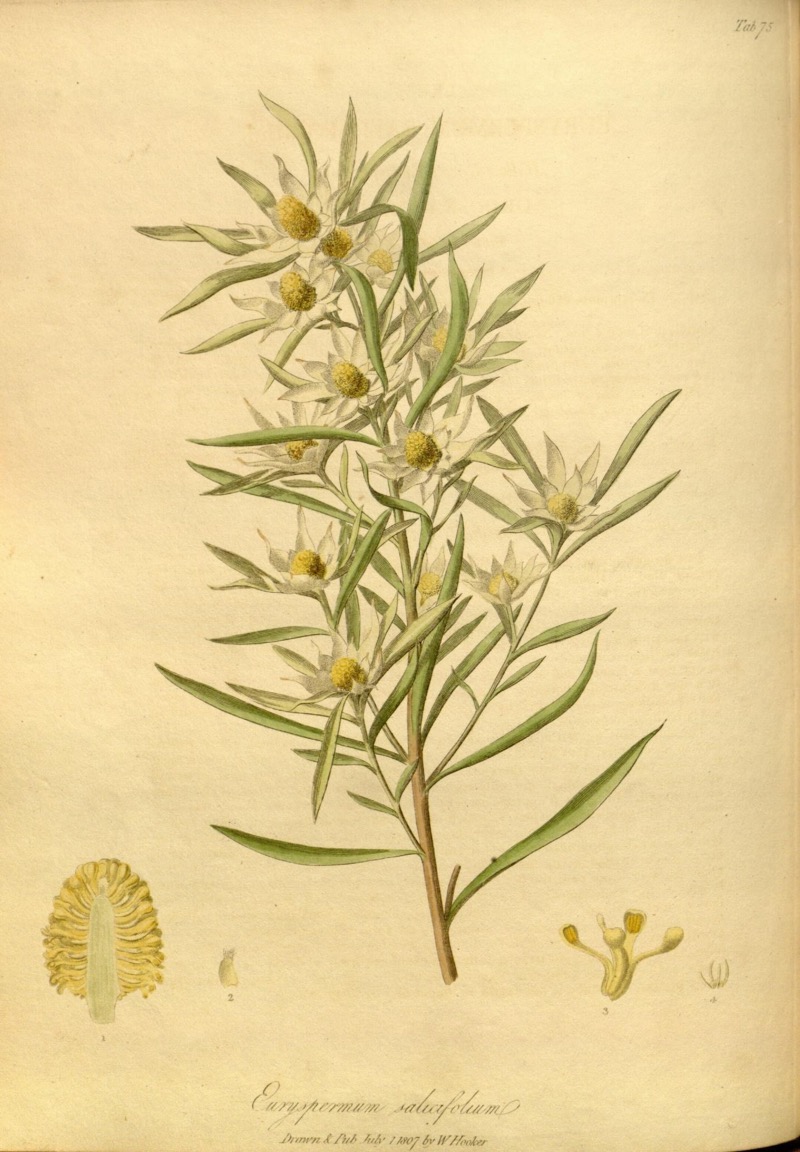
According to SANBI, Linnaeus placed the silver tree in Protea; after Salisbury and Robert Brown reorganised the family into its modern genera in 1807–1810, Brown redefined and conserved the name Leucadendron on the silver tree (cited by WCVP as R.Br., 1810). Names Salisbury used, such as Euryspermum, are now synonyms (see below). The plate above, from Paradisus Londinensis (1807), plate 75, is printed Euryspermum salicifolium, now Leucadendron salicifolium.
SANBI describes the male flower heads of the silver tree as bright yellow balls and the female heads as near-spherical cones of overlapping bracts; the seeds carry a plumed appendage and are dispersed by wind.
| Genus name | Published in |
|---|---|
| Chasme Salisb. | Parad. Lond. 1: t. 67 (1807) |
| Euryspermum Salisb. | Parad. Lond. 2: t. 75 (1807) |
| Gissonia Salisb. ex Knight | Cult. Prot.: 32 (1809) |
| Vionaea Neck. | Elem. Bot. 1: 107 (1790) |
Distribution
WCVP records the genus as native to 2 TDWG botanical regions.
Cape ProvincesKwaZulu-Natal
Accepted species
WCVP accepts 85 species; names with × are natural hybrids. The count changes with revisions; checked 2026-10-24.
| Name | On this site |
|---|---|
| Leucadendron album (Thunb.) Fourc. | |
| Leucadendron arcuatum (Lam.) I.Williams | |
| Leucadendron argenteum (L.) R.Br. | |
| Leucadendron barkerae I.Williams | |
| Leucadendron bonum I.Williams | |
| Leucadendron brunioides Meisn. | |
| Leucadendron burchellii I.Williams | |
| Leucadendron cadens I.Williams | |
| Leucadendron chamelaea (Lam.) I.Williams | |
| Leucadendron cinereum (Aiton) R.Br. | |
| Leucadendron comosum R.Br. | |
| Leucadendron concavum I.Williams | |
| Leucadendron conicum (Lam.) I.Williams | |
| Leucadendron coniferum (L.) Sieber ex Meisn. | |
| Leucadendron cordatum E.Phillips | |
| Leucadendron coriaceum E.Phillips & Hutch. | |
| Leucadendron corymbosum P.J.Bergius | |
| Leucadendron cryptocephalum L.Guthrie | |
| Leucadendron daphnoides Meisn. | |
| Leucadendron diemontianum I.Williams | |
| Leucadendron discolor E.Phillips & Hutch. | |
| Leucadendron dregei E.Mey. ex Meisn. | |
| Leucadendron dubium (Meisn.) E.Phillips & Hutch. | |
| Leucadendron elimense E.Phillips | |
| Leucadendron ericifolium R.Br. | |
| Leucadendron eucalyptifolium H.Buek ex Meisn. | |
| Leucadendron flexuosum I.Williams | |
| Leucadendron floridum R.Br. | |
| Leucadendron foedum I.Williams | |
| Leucadendron galpinii E.Phillips & Hutch. | |
| Leucadendron gandogeri Schinz ex Gand. | |
| Leucadendron glaberrimum (Schltr.) Compton | |
| Leucadendron globosum (Andrews) I.Williams | |
| Leucadendron glutinosum (Knight) Hutch. | |
| Leucadendron gydoense I.Williams | |
| Leucadendron immoderatum Rourke | |
| Leucadendron lanigerum H.Buek ex Meisn. | |
| Leucadendron laureolum (Lam.) Fourc. | |
| Leucadendron laxum I.Williams | |
| Leucadendron levisanus (L.) P.J.Bergius | |
| Leucadendron linifolium (Jacq.) R.Br. | |
| Leucadendron loeriense I.Williams | |
| Leucadendron loranthifolium (Salisb. ex Knight) I.Williams | |
| Leucadendron macowanii E.Phillips | |
| Leucadendron meridianum T.M.Salter ex I.Williams | |
| Leucadendron meyerianum H.Buek ex E.Phillips & Hutch. | |
| Leucadendron microcephalum (Gand.) Gand. & Schinz | |
| Leucadendron modestum I.Williams | |
| Leucadendron muirii E.Phillips | |
| Leucadendron nervosum E.Phillips & Hutch. | |
| Leucadendron nitidum H.Buek ex Meisn. | |
| Leucadendron nobile I.Williams | |
| Leucadendron olens I.Williams | |
| Leucadendron orientale I.Williams | |
| Leucadendron osbornei Rourke | |
| Leucadendron platyspermum R.Br. | |
| Leucadendron pondoense A.E.van Wyk | |
| Leucadendron procerum (Salisb. ex Knight) I.Williams | |
| Leucadendron pubescens R.Br. | |
| Leucadendron pubibracteolatum I.Williams | |
| Leucadendron radiatum E.Phillips & Hutch. | |
| Leucadendron remotum I.Williams | |
| Leucadendron roodii E.Phillips | |
| Leucadendron rourkei I.Williams | |
| Leucadendron rubrum Burm.f. | |
| Leucadendron salicifolium (Salisb.) I.Williams | 1 plate |
| Leucadendron salignum P.J.Bergius | |
| Leucadendron sericeum (Thunb.) R.Br. | |
| Leucadendron sessile R.Br. | |
| Leucadendron sheilae I.Williams | |
| Leucadendron singulare I.Williams | |
| Leucadendron sorocephalodes E.Phillips & Hutch. | |
| Leucadendron spirale (Salisb. ex Knight) I.Williams | |
| Leucadendron spissifolium (Salisb. ex Knight) I.Williams | |
| Leucadendron stellare (Sims) R.Br. ex Steud. | |
| Leucadendron stelligerum I.Williams | |
| Leucadendron strobilinum (L.) Druce | |
| Leucadendron teretifolium (Andrews) I.Williams | |
| Leucadendron thymifolium (Salisb. ex Knight) I.Williams | |
| Leucadendron tinctum I.Williams | |
| Leucadendron tradouwense I.Williams | |
| Leucadendron uliginosum R.Br. | |
| Leucadendron verticillatum (Thunb.) Meisn. | |
| Leucadendron vinimontis Rebelo | |
| Leucadendron xanthoconus (Kuntze) K.Schum. |
Historic plates
Plates in date order; the printed names are kept as they appear, current names are on the species pages and the topic page.
Euryspermum salicifolium
The Paradisus Londinensis · Tab. 75 · 1807
William Hooker
Cut-foliage cultivars and growing
SANBI describes L. salignum as the most widespread species in the protea family, with a long flowering season (May to December) and leaves and bracts ranging from greenish-yellow to vivid orange-red, which makes it an excellent breeding subject; it tolerates hard pruning, suiting large-scale cut-foliage production, and many cultivars and hybrids have been raised. The best known, ‘Safari Sunset’, is a hybrid of L. laureolum × L. salignum grown as an export crop in several countries: a tall shrub to 2.5 m with large deep-red bracts on long stems that open to show cream centres; ‘Silvan Red’ is a hybrid of the same two species with slightly lighter colour. Cultivars and hybrids can only be propagated from cuttings.
The silver foliage of the silver tree is also used in floristry and lasts well in the vase; like most proteas it dislikes soggy soil, still humid air and strong fertilisers, and needs sun, good air circulation and well-drained sandy soil (SANBI).