Freesia Eckl. ex Klatt
freesias · Iridaceae
- Accepted name
- Freesia Eckl. ex Klatt
- First published
- Linnaea 34: 672 (1866)
- Family
- Iridaceae
- Accepted species
- 17 (including 1 natural hybrids)
- Native range
- 15 TDWG regions, Kenya to southern Africa
- Common names
- freesias
- Databases
- POWO · IPNI · WCVP · Catalogue of Life · GBIF
Overview
Freesia belongs to the iris family, Iridaceae; Kew gives its native range as Kenya to southern Africa. The RHS notes that freesias come from South Africa, with bright, strongly scented flowers, and because they need conditions like their native habitat, they are more often bought as cut flowers than grown from corms.
On this site the cut-flower freesia is identified as the hybrid Freesia × kewensis, which WCVP accepts; WCVP records F. refracta and F. leichtlinii as native to the Cape Provinces.
Classification and characters
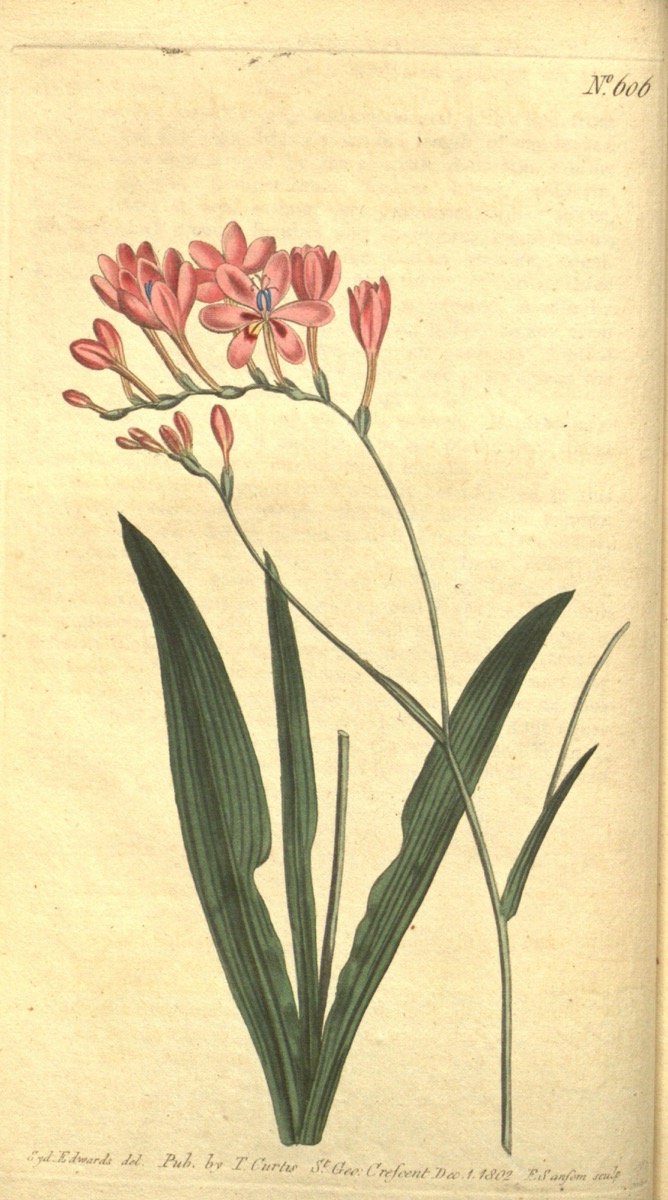
Klatt published the name in 1866 (cited by WCVP as Eckl. ex Klatt). WCVP includes Anomatheca, so the genus holds both the scented cut-flower species and small plants once called Anomatheca or Lapeirousia. The plate above, from Curtis’s Botanical Magazine, plate 606 (1802), is named in the text as Lapeyrousia juncea, a synonym of Freesia verrucosa in WCVP.
Flora of Tropical East Africa describes perennials with corms in fibrous tunics, a spike usually flexed at the base, and bilaterally symmetrical flowers in shades of pink to red, or whitish.
| Genus name | Published in |
|---|---|
| Anomatheca Ker Gawl. | Ann. Bot. (König & Sims) 1: 227 (1804) |
| Nymanina Kuntze | Revis. Gen. Pl. 2: 701 (1891) |
Distribution
WCVP records the genus as native to 15 TDWG botanical regions and introduced in 25 more.
Cape ProvincesDR CongoEswatiniFree StateKenyaKwaZulu-NatalMalawiMozambiqueNamibiaNorthern ProvincesRwandaTanzaniaUgandaZambiaZimbabwe
Introduced
Argentina NortheastBalearesBermudaCaliforniaCanary Is.CorseEast Aegean Is.FloridaFranceGreeceItalyJapanKritiMadeiraMauritiusNew South WalesNorfolk Is.PortugalRéunionSardegnaSiciliaSpainSt.HelenaTunisiaTürkiye
Accepted species
WCVP accepts 17 species; names with × are natural hybrids. The count changes with revisions; checked 2026-10-24.
| Name | On this site |
|---|---|
| Freesia andersoniae L.Bolus | |
| Freesia caryophyllacea (Burm.f.) N.E.Br. | |
| Freesia corymbosa (Burm.f.) N.E.Br. | |
| Freesia fergusoniae L.Bolus | |
| Freesia fucata J.C.Manning & Goldblatt | |
| Freesia grandiflora (Baker) Klatt | 1 plate |
| Freesia × kewensis J.Wright bis | |
| Freesia laxa (Thunb.) Goldblatt & J.C.Manning | |
| Freesia leichtlinii Klatt | |
| Freesia marginata J.C.Manning & Goldblatt | |
| Freesia occidentalis L.Bolus | |
| Freesia praecox J.C.Manning & Goldblatt | |
| Freesia refracta (Jacq.) Klatt | |
| Freesia sparrmanii (Thunb.) N.E.Br. | |
| Freesia speciosa L.Bolus | |
| Freesia verrucosa (B.Vogel) Goldblatt & J.C.Manning | 1 plate |
| Freesia viridis (Aiton) Goldblatt & J.C.Manning |
Historic plates
Plates in date order; the printed names are kept as they appear, current names are on the species pages and the topic page.
Lapeyrousia juncea
Curtis's Botanical Magazine · 606 · 1802
Sydenham Edwards
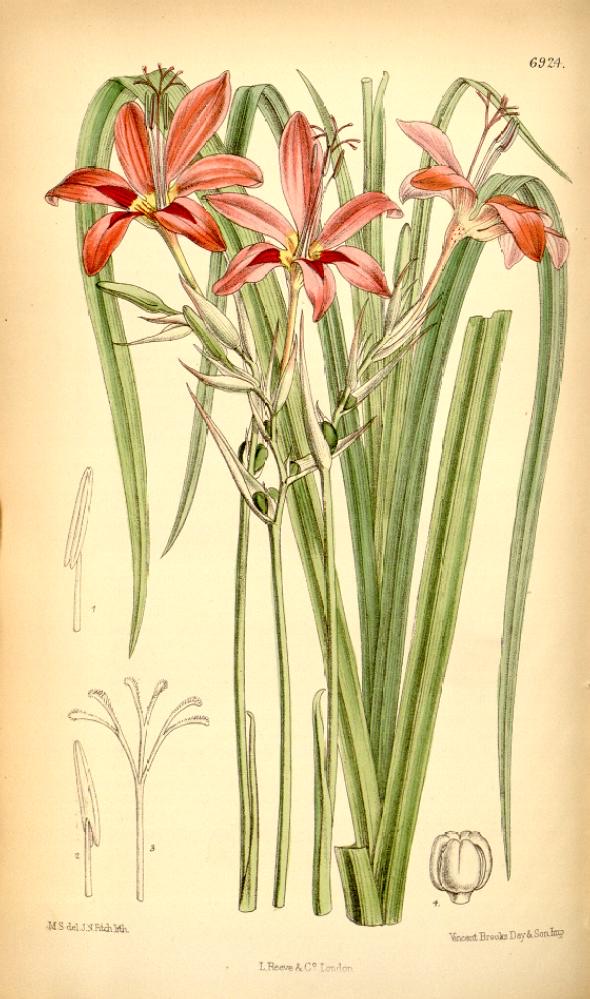
Lapeirousia grandiflora
Curtis's Botanical Magazine · 6924 · 1887
Matilda Smith, John Nugent Fitch
Growing and cut-flower handling
The RHS notes that freesias are sold as corms, prepared or unprepared; prepared corms are heat-treated to flower earlier but flower only once. Planted in containers from August to December, they flower from January to April; keep them cool at first, then move them to a cool greenhouse or conservatory. They make long-lasting cut flowers.
Floralife advises choosing stems with the first bud almost fully developed but not open and the remaining buds showing colour; stems cut too green may not open all their buds. Store at 1–3 °C and 75–85% relative humidity; vase life is 4–12 days. Freesias are sensitive to desiccation and do not tolerate dry shipping and storage; they are fluoride-sensitive, which burns the leaf tips, so avoid fluoridated and softened water; they are moderately ethylene-sensitive, which causes bud drop and transparent petals; and the leaves yellow easily, which a bulb flower food helps.