Epipremnum Schott
pothos and other epipremnums · Araceae
- Accepted name
- Epipremnum Schott
- First published
- Bonplandia (Hannover) 5: 45 (1857)
- Family
- Araceae
- Accepted species
- 15 (including 0 natural hybrids)
- Native range
- 39 TDWG regions, tropical and subtropical Asia to the Pacific
- Common names
- pothos and other epipremnums, epipremnums
- Databases
- POWO · IPNI · WCVP · Catalogue of Life · GBIF
Overview
Epipremnum belongs to the arum family, Araceae; Kew gives its native range as tropical and subtropical Asia to the Pacific. The most familiar houseplant, pothos or devil’s ivy, is E. aureum: WCVP records it as native only to the Society Islands in the South Pacific and introduced in about 40 regions worldwide, including south-east China. The RHS describes it as an easy climber with glossy heart-shaped leaves and stems that reach 2 m or more, trailing from a hanging pot or trained up a moss pole.
Classification and characters
Schott published the genus in 1857. CATE Araceae describes evergreen climbing herbs that produce whip-like shoots; in humid tropical forest they are high-climbing hemiepiphytes on trees and rocks; the leaves are several to many, in two ranks, the blade usually entire or divided into lobes, with parallel side veins.
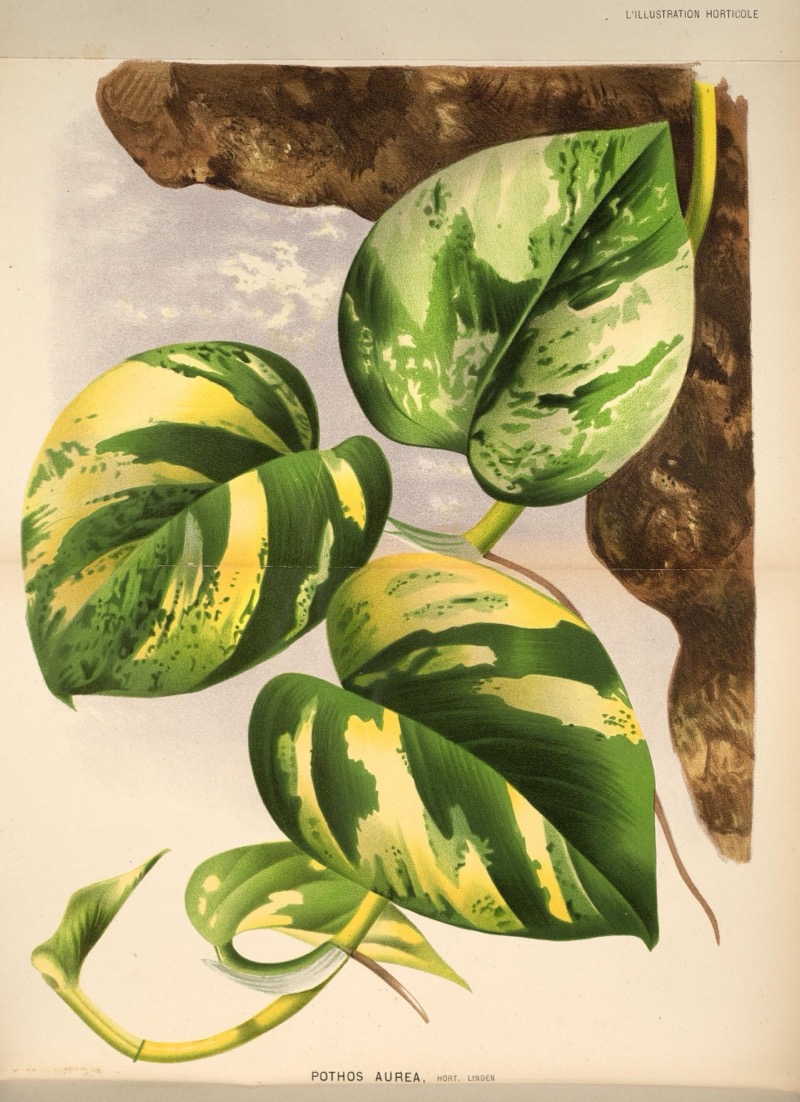
The plate above, L’Illustration horticole (1880), plate 381, is printed “Pothos aurea, Hort. Linden”: in WCVP, Pothos aureus Linden & André is the basionym of pothos’s current name, Epipremnum aureum. The older name Scindapsus aureus is also a synonym.
| Genus name | Published in |
|---|---|
| Anthelia Schott | Ann. Mus. Bot. Lugduno-Batavi 1: 127 (1863) |
Distribution
WCVP records the genus as native to 39 TDWG botanical regions and introduced in 30 more.
Andaman Is.AssamBangladeshBismarck ArchipelagoBorneoCambodiaCaroline Is.China South-CentralChina SoutheastCook Is.FijiHainanIndiaJawaLaosLesser Sunda Is.MalayaMalukuMarshall Is.MyanmarNansei-shotoNew CaledoniaNew GuineaNicobar Is.Northern TerritoryPhilippinesQueenslandSamoaSanta Cruz Is.Society Is.Solomon Is.SulawesiSumateraTaiwanThailandTongaVanuatuVietnamWallis-Futuna Is.
Introduced
BermudaBrazil NortheastBrazil SoutheastCameroonChagos ArchipelagoColombiaComorosCosta RicaCubaDominican RepublicEcuadorFloridaGuineaGulf StatesHaitiHawaiiHondurasIvory CoastKenyaLeeward Is.Line Is.Ogasawara-shotoPuerto RicoSeychellesSri LankaSurinameTrinidad-TobagoTuamotuVenezuelan AntillesWindward Is.
Accepted species
WCVP accepts 15 species; names with × are natural hybrids. The count changes with revisions; checked 2026-10-24.
| Name | On this site |
|---|---|
| Epipremnum amplissimum (Schott) Engl. | |
| Epipremnum aureum (Linden & André) G.S.Bunting | 1 plate |
| Epipremnum carolinense Volkens | |
| Epipremnum ceramense (Engl. & K.Krause) Alderw. | |
| Epipremnum dahlii Engl. | |
| Epipremnum falcifolium Engl. | |
| Epipremnum giganteum (Roxb.) Schott | |
| Epipremnum meeboldii K.Krause | |
| Epipremnum moluccanum Schott | |
| Epipremnum moszkowskii K.Krause | |
| Epipremnum nobile (Schott) Engl. | |
| Epipremnum obtusum Engl. & K.Krause | |
| Epipremnum papuanum Alderw. | |
| Epipremnum pinnatum (L.) Engl. | |
| Epipremnum silvaticum Alderw. |
Historic plates
Plates in date order; the printed names are kept as they appear, current names are on the species pages and the topic page.
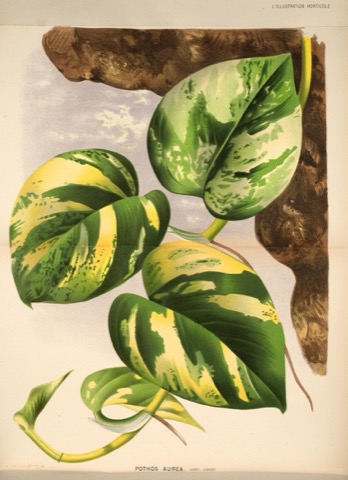
Pothos aurea, Hort. Linden
L'Illustration horticole · Pl. CCCLXXXI · 1880
Growing indoors and safety
The RHS advises bright, indirect light; it will grow in some shade, though more slowly, and deep shade gives poor growth and less variegation. Avoid overwatering: let the top 2 cm of compost dry between waterings, as excess water, especially in winter, rots the roots, and cold draughts are damaging. The RHS warns that it is toxic and should be kept away from children and pets; the ASPCA lists golden pothos as toxic to dogs and cats, its insoluble calcium oxalates causing oral burning, excessive drooling, vomiting and difficulty swallowing.