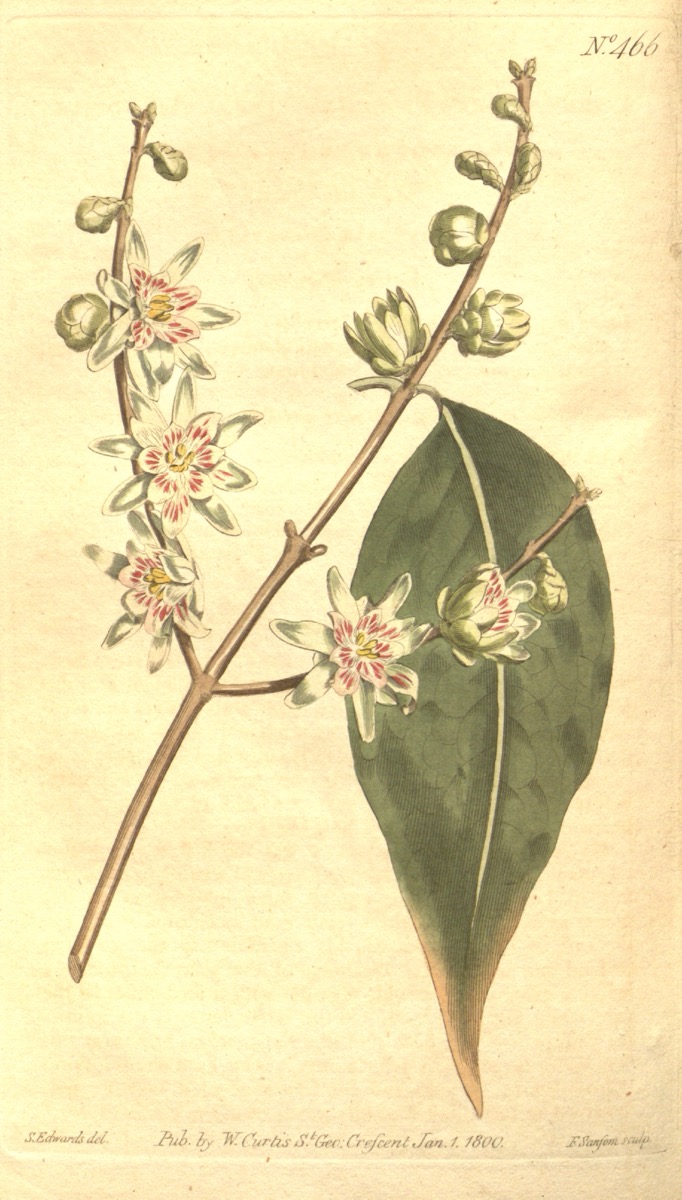
Chimonanthus Lindl.
wintersweets · Calycanthaceae
- Accepted name
- Chimonanthus Lindl.
- First published
- Bot. Reg. 5: t. 404 (1819)
- Family
- Calycanthaceae
- Accepted species
- 6 (including 0 natural hybrids)
- Native range
- 3 TDWG regions, China (north-central, south-central and south-east)
- Common names
- wintersweets
- Databases
- POWO · IPNI · WCVP · Catalogue of Life · GBIF
Overview
Chimonanthus belongs to the family Calycanthaceae and is a small genus: WCVP accepts only a handful of species, all native to north-central, south-central and south-east China. The wintersweet branches florists sell in winter are C. praecox; despite the similar Chinese name (lamei), it is unrelated to the Japanese apricot, Prunus mume (meihua).
Classification and naming
Lindley published the genus in the Botanical Register in 1819 (WCVP). Linnaeus first placed wintersweet in Calycanthus, as Calycanthus praecox; Link moved it to Chimonanthus in 1822, giving the current name Chimonanthus praecox (L.) Link (WCVP). The plate above, Curtis’s Botanical Magazine plate 466 (1800), still names it in the text “Calycanthus Praecox. Japan All-spice”.
| Genus name | Published in |
|---|---|
| Meratia Loisel. | Herb. Gén. Amat. 3: t. 173 (1819 publ. 1818) |
Distribution
WCVP records the genus as native to 3 TDWG botanical regions.
China North-CentralChina South-CentralChina Southeast
Accepted species
WCVP accepts 6 species; names with × are natural hybrids. The count changes with revisions; checked 2026-10-24.
| Name | On this site |
|---|---|
| Chimonanthus campanulatus R.H.Chang & C.S.Ding | |
| Chimonanthus grammatus M.C.Liu | |
| Chimonanthus nitens Oliv. | |
| Chimonanthus praecox (L.) Link | 1 plate |
| Chimonanthus salicifolius S.Y.Hu | |
| Chimonanthus zhejiangensis M.C.Liu |
Historic plates
Plates in date order; the printed names are kept as they appear, current names are on the species pages and the topic page.
Calycanthus praecox
Curtis's Botanical Magazine · 466 · 1800
Sydenham Edwards
Growing
The RHS describes the cultivar ‘Luteus’ as having pale yellow flowers, pure in colour and not marked with red, with a sweet scent. It is perfectly hardy in the open garden (RHS hardiness rating H5) but needs the extra summer warmth of a fence or wall to ripen its shoots and develop the buds for its winter flowers. Plant it near a path or door to enjoy the scent, prune after flowering if necessary; it grows to about 2.5 m.